 TH
TH  EN
EN 
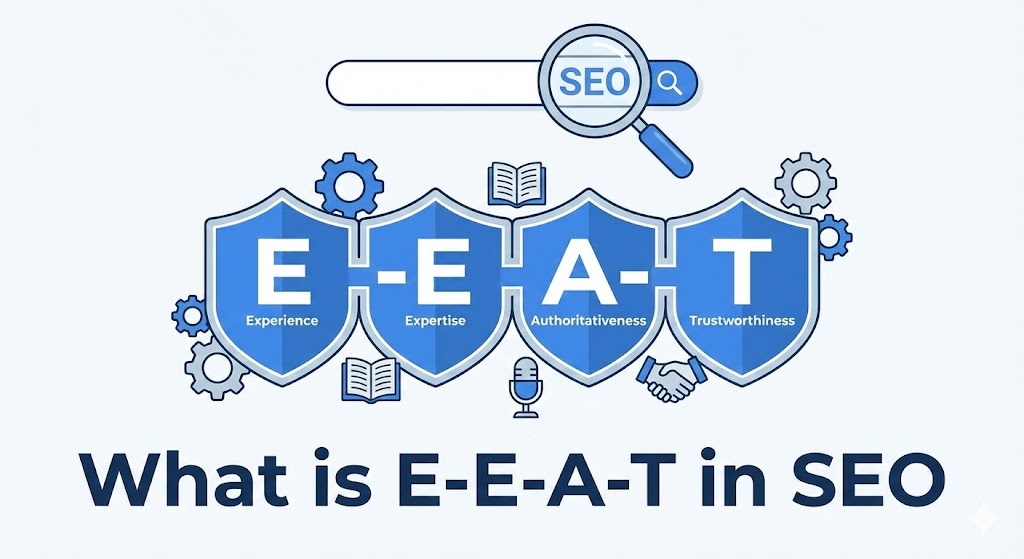
Moving beyond just keywords and backlinks, Google is always evolving to make search more effective for every user. Today, the search engine evaluates content through a framework that determines whether your business deserves to rank at all.
This framework is called E-E-A-T, and understanding it has become essential for any business that is serious about appearing more visible online. E-E-A-T signals can make the difference between ranking on page one or remaining invisible. Here’s what Thai business owners need to know about this critical ranking framework.
Understanding E-E-A-T: Google’s Trust Framework
E-E-A-T stands for Experience, Expertise, Authoritativeness, and Trustworthiness. It represents Google’s method for evaluating whether content deserves to rank in search results. The framework originated as E-A-T in 2014 within Google’s Search Quality Rater Guidelines, but Google added the extra “E” for Experience in December 2022, recognizing that first-hand experience is just as valuable as professional credentials for many topics.
Think of E-E-A-T as Google’s way of asking: “Should users trust this content?” The framework helps human quality raters evaluate search results, and while E-E-A-T isn’t a direct ranking factor, it influences the algorithms that determine which pages appear at the top of search results.
Google made clear in its announcement that content demonstrating actual use of a product, having visited a place, or communicating what a person experienced carries significant weight in deciding whether the content is valuable.
The shift matters because Google wants to show content that genuinely helps people, not content engineered purely for rankings. This means your website needs to demonstrate real authority and trustworthiness, not just old optimization tactics.
The Four Pillars of E-E-A-T Explained

Understanding what is E-E-A-T in SEO requires breaking down each component and recognizing how they work together to build credibility.
Experience refers to first-hand involvement with your subject matter. This could mean actually using the products you review, visiting the locations you recommend, or implementing the strategies you discuss. For an e-commerce site selling electronics, it means testing the devices for example. Experience adds authenticity that readers and search engines both recognize. Google specifically noted that authentic experience is currently outside the scope of AI capabilities, making genuine human experience a competitive advantage.
Expertise involves demonstrating knowledge and credentials in your field. This might mean formal education, professional certifications, or deep practical knowledge gained through years of work. A financial advisor writing about retirement planning should showcase their credentials. A digital marketing agency discussing SEO should demonstrate technical knowledge and proven results. Expertise can be formal or informal, but it must be evident in the depth and accuracy of your content.
Authoritativeness reflects your reputation among peers and within your industry. Are other experts citing your work? Do reputable publications mention your brand? Have you received industry awards or recognition? Authoritativeness is built over time through consistent quality work, media mentions, speaking engagements, and becoming a go-to source in your field. It’s about external validation, not self-promotion.
Trustworthiness serves as the foundation of E-E-A-T. Google has explicitly stated that trust is the “most important member of the E-E-A-T family.” Trustworthiness encompasses accuracy, transparency, security, and reliability. This includes having clear contact information, transparent business practices, secure website protocols, accurate content, and genuine customer reviews. For Thai businesses, where 77% of consumers express concerns about privacy and data sharing, demonstrating trustworthiness has never been more critical.
Why E-E-A-T Matters More for Thai Businesses in 2026
The importance of E-E-A-T has intensified with the rise of AI-powered search. Google’s AI Overviews now appear in over 50% of searches, and these AI systems rely heavily on E-E-A-T signals to determine which sources to cite. Research shows that AI Overviews leverage Google’s ranking systems to determine which sources are most authoritative, making E-E-A-T crucial for visibility in both traditional and AI-driven search results.
For certain content categories, E-E-A-T requirements are exceptionally high. Google designates topics that could impact health, finances, safety, or well-being as “Your Money or Your Life” (YMYL) content. Healthcare, financial services, legal advice, and major purchase decisions all fall under YMYL. Studies show that legal content triggers AI Overviews 77% of the time, health content 65%, and finance content 41%, but the bar for meeting E-E-A-T standards in these categories is correspondingly higher.
The Thai market presents unique E-E-A-T challenges. Thai consumers demonstrate sophisticated validation behaviors, with 82% discovering brands through social media and 62% purchasing products endorsed by influencers. Yet despite this heavy social media usage, Thai consumers rate companies and social platforms as the least trustworthy sources. This paradox means Thai businesses must work harder to establish credible trust signals that extend beyond social media popularity.
This trust gap is real because consumers actively seek validation across multiple platforms before purchasing, your E-E-A-T signals need to be consistent everywhere they look. LINE Official Account verification, customer reviews on multiple platforms, media mentions in Thai publications, and transparent business practices all contribute to the trust equation.
How to Build E-E-A-T for Your Business Website
Building strong E-E-A-T signals requires systematic effort across multiple areas. Start with the fundamentals that demonstrate transparency and credibility.
Demonstrate clear authorship and credentials. Every piece of content should include detailed author bios showing relevant experience and expertise. If a medical professional reviews health products, prominently display their credentials. If a business consultant writes about strategy, show their track record. Thai businesses should consider bilingual author profiles that work for both Thai and English-speaking audiences, expanding reach while maintaining credibility.
Showcase first-hand experience through authentic content. Include customer testimonials with real names and photos (with permission from your customers). Create detailed case studies showing actual results. Share behind-the-scenes processes that demonstrate your work. Use original photos and videos rather than generic stock imagery. When reviewing products or services, provide specific details that only come from actual use.
Build and display authoritative signals. Earn media mentions in reputable Thai publications and industry sites. Pursue speaking opportunities at conferences and events. Apply for industry awards and certifications. Secure quality backlinks from authoritative domains in your sector. These external validations carry significant weight because they can’t be self-generated.
Establish comprehensive trust markers. Ensure your website uses HTTPS security protocols. Maintain detailed, current About and Contact pages with real business information. Display genuine customer reviews and respond to feedback professionally. Provide transparent pricing, clear policies, and accessible customer service. Link to authoritative sources when citing statistics or research. For Thai businesses, consider displaying trust badges from recognized local organizations and payment security certifications that Thai consumers recognize.
Create topic clusters that demonstrate depth. Rather than surface-level content on many topics, build comprehensive coverage of core subjects related to your business. Develop pillar content that thoroughly addresses main topics, supported by detailed articles covering specific subtopics. This structure demonstrates expertise through comprehensive knowledge rather than scattered information.
For Thai businesses specifically, leverage local trust signals. LINE Official Account verification carries weight with Thai consumers. Recognition from Thai government agencies, industry associations, or consumer protection organizations adds credibility. Partnerships with established Thai brands provide authoritative associations.
E-E-A-T and the Future of Search Visibility
As AI continues to reshape search, E-E-A-T principles become even more critical. AI systems prioritize recognized authorities when generating answers, and brands with verified expertise, structured citations, and widespread recognition gain disproportionate visibility. The shift from traditional search to AI-synthesized answers means that weak E-E-A-T signals will exclude you from consideration entirely.
For Thai businesses, this creates both challenge and opportunity. The challenge lies in building E-E-A-T signals that resonate across cultures and languages, meeting both Thai consumer expectations and global search engine standards. The opportunity exists for businesses that invest systematically in genuine authority and trustworthiness to stand out in a landscape where many competitors focus solely on keywords and links.
E-E-A-T isn’t a quick fix or a simple checklist. It represents a fundamental shift toward rewarding genuine expertise, real experience, earned authority, and demonstrated trustworthiness. Thai businesses that embrace this shift, building real credibility rather than gaming the system, will capture increasing visibility as search continues evolving toward quality over optimization tricks.
The question isn’t whether to invest in E-E-A-T but how quickly you can begin. Every piece of content published, every customer review earned, every media mention secured, and every transparent business practice implemented contributes to the trust signals that determine your search visibility today and tomorrow.